| CLICK Here to make us your HOMEPAGE! |
| Today is 9 June, 2008 |
| Bookmark Us |
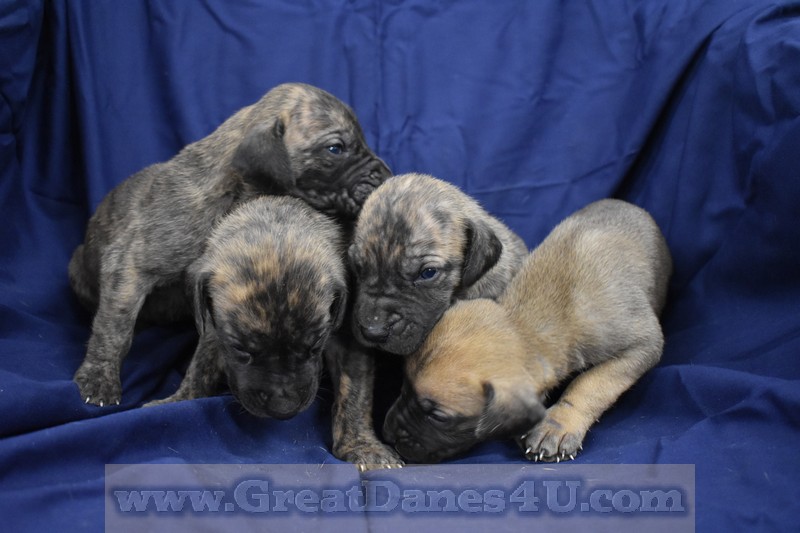
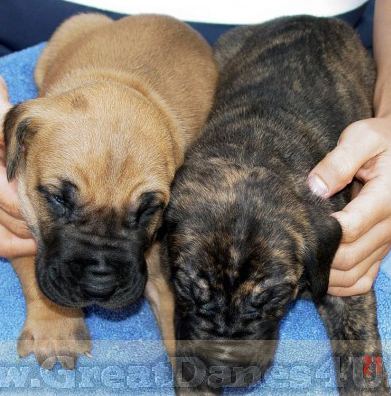
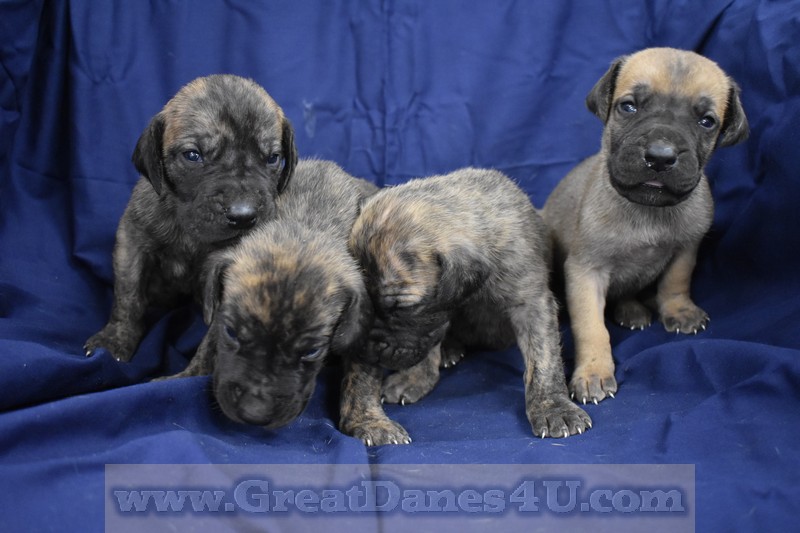
GreatDanes4U uses this site to promote Healthy, Trained, Socialized 6-Generation Color-Pure FAWN and
BRINDLE AKC Great Dane Puppies, Big Pups and Dogs for sale as
Family Pets, Breeding Quality and Show Potential pups and Stud Service as
well..
All stock is Micro chipped and DNA Profiled. Both studs are OFA
Certified.
All pups go micro-chipped, 2 applications of Kennel Cough, 2
Parvo shots, dewclaw removal and at least 1 Vet check,
most go home close to
Housebroke!
Enclosed within this web site is Free Information all about
Great Danes Appearance, Standards, K-9 Care, Breeder Policies or Dane History and many Pictures of Great Danes.
Please
send your comments, suggestions, or to be registered in the litter email
database; send you email request to:
sales@greatdanes4u.com
or just pick up
the phone,
call: 417.267.3498 for a
*LIVE* Web Cam
appointment or for any further information!
Use Blue Menu Bar (Below), or Text link Site Map in footer to Navigate this extensive website.
http://www.chetbacon.com/wobblers.htm
A collection of information about Wobblers Disease
SPONDYLOLITHESIS
WOBBLERS SYNDROME
Description
Wobblers syndrome is caused by a narrowing or malformation of the spinal
cervical (neck) vertebrae which causes pressure on the spinal cord by the lower
cervical (neck) vertebrae due to either a malformation of the vertebra or a
malocclusion (when the vertebrae do not come together properly). This causes
anywhere from a mild, to a severe affect in the dogs gait.. Other conditions can
mimic the symptoms. The only definitive diagnosis of Wobblers Syndrome or
Spondololithesis, is a mylogram where dye is injected into the spinal column and
then the neck is flexed and x-rayed.
Breeds affected: - Dobermans and Great Danes primarily - young Danes more
commonly affected. Dobermans - young and old, can grow through the problem as
youngsters, more commonly seen in middle aged to older Dobermans (3 to 9 years
of age) Other breeds who have a similar if not identical syndrome described
include the Boxer, Basset, Bull Mastiff, St. Bernard, Weimeraner, Labrador
Retriever, German Shepherd, Rhodesian Ridgeback, Dalmatian, Samoyed, Old English
Sheepdog, Irish Setter, and the Borzoi. Males are affected more often, in a
ratio of 2:1
Cause
The cause of Wobblers Syndrome is unknown, although a link to fast growth and
genetics is suspected. According to the Merck Veterinary Manual, "The cause is
unknown, although rapid growth rates and nutrition, mechanical factors, and
genetics may be implicated." Some breeders say that there has been a marked
decrease in the incidence of not only Wobblers Syndrome, but other diseases that
occur during the early, fast growth stages of Great Danes, when weight is kept
down and growth rate has been slowed nutritionally.
Symptoms
Symptoms usually appear first in the rear legs as a mild uncoordination in gait
(ataxia) and can escalate to involvement of the forelegs as well. The severely
affected dog moves like a drunk and the uncoordination shows up most when the
dog is walked and then moved sharply into a turn. An unsuspecting owner might
simply conclude that his older puppy was just clumsy. Overly clumsy young Great
Danes should be Wobbler suspects.
In Great Danes, Wobblers Syndrome most commonly appears from 10 months to a year
and a half of age although it can manifest as old as 4 or 5 years, and as young
as 5 weeks. In Doberman Pinschers it usually doesn't appear until the dog is 4
or 5 years old.
Diagnosis
A veterinarian will do a neurological work up on the dog and this often includes
not only cervical spine x-rays, but a mylogram x-ray. A mylogram is not only
dangerous to the dog, but is expensive. The owner should thoroughly investigate
the advisability of this procedure, especially since if it is Wobblers Syndrome,
surgery may not be the best option.
Treatment
Treatment of Wobblers Syndrome can include the use of corticosteroids, a neck
brace and surgery. The surgery fuses the 2 unstable vertebrae which relieves the
pressure on the spinal cord. Unfortunately this also puts further stress on
adjoining vertebrae which can cause instability to recur in them. Many Wobblers
can live a long and pain free life with little or no treatment. Others
deteriorate quickly and euthanasia then becomes the only kind choice.
-----------
Wobbler's Syndrome
by Bruce R. Wittels, D.V.M.
This is the first in a series of articles that will discuss specific disease
entities of bone caused, in part, by improper or over nutrition. Some of the
information to be presented in this and future articles will have been discussed
previously but will be put into specific consideration to the disease entity
covered. It is my desire to provide an understanding of the total picture of
proper nutrition and a well balanced and strong skeleton upon which these modern
day giants are to support their massive bodies. If the foundation of any
structure is weak, then the weight which is born by it will cause this
foundation to break and fall.
The principal breed affected with Wobbler's Syndrome is the Great Dane.
Cervical Spondylopathy or Canine Wobblers Syndrome as the lay person knows it,
consists of any uncoordination or lameness caused by pressure on the spinal cord
as it travels through the neck (at any age for any reason).
In Great Danes, a true wobbler is usually seen between the ages of 3-12 months
of age. The outstanding symptom is a slowly developing, progressive,
uncoordination and paralysis of the hind limbs. This paresis and/or
uncoordination is caused by pressure on the spinal cord as it passes through the
vertebrae of the neck, the last three being the most prominent sites. The animal
may appear clumsy, "wobbling" or display swaying of the rear legs. On slick
surfaces it may be difficult or impossible to walk. The dog may fall when
attempting to turn and the toes of the hind feet may drag
when walking. The dog usually has its legs spread out as far as possible trying
to better balance itself. Initially front leg involvement is minimal or
undetectable. As the disease progresses, a characteristic short choppy rolling
stride is seen on what appears to be somewhat rigid forelimbs. As the
compression of the spinal cord becomes more severe, the front legs can have the
same signs as the rear legs. There is usually little or no neck pain but the dog
may stand with the neck flexed which usually alleviates some of the spinal cord
pinching. Many dogs will object to neck manipulation and may even collapse when
the movement is forced.
On occasion, there can be an acute onset of signs. They are usually more severe
than with the progressive type. Forelimb involvement is usually present. There
is also a higher incidence of neck pain with the acute onset. This type of
wobblers is seen most frequently in five to seven year old Doberman Pinchers and
is rarely seen in young Danes. This must be differentiated from similar signs
caused by cervical disc protrusion or a fractured vertebrae.
The pressure of the spinal cord is due to improper formation of the anatomical
parts surrounding the spinal cord during growth. The pressure can be due to one
or a combination of the following:
1. weak ligaments which hold the vertebral bodies in place - this allows
irregular movement of the vertebral bodies as the neck is placed in various
positions (subluxations) and causes a pinching of the spinal cord.
2.hyperplasia of the yellow ligaments - normally these are thin loose elastic
sheets located between the arches of adjacent vertebrae. Just beneath them is
the small epidermal space which is immediately above the spinal cord. With
enlargement of these ligaments, the epidermal space is obliterated and the
yellow ligaments push directly on the spinal cord.
3. malformation of the vertebrae - this can happen in various ways i.e.:
a. Vertibral or spinal canal that is too small for the diameter of the spinal
cord
b. Assymetric cartilage defects which cause vertebral subluxations
c. Osteochondrosis of the articular facets which also lead to subluxations
d. Stenosis of the cranial orifices of vertebral foramina which causes a
pinching of the nervous system
DIAGNOSIS
This is based on the breed, age, history and results of both a physical and
neurological examination. Diagnosis is confirmed by radiographic examination. A
minimum of three views should be taken: a side view with the neck in normal
position, a side view with the neck in a flexed position (head pointed towards
the feet), and a side view with the head in a skyward position. A subluxation of
one or more vertebrae may be the only causative agent and is often only seen
when the neck is in and extended or flexed position. At times, a view of the
neck from top to bottom must be taken. A mylogram might be needed to properly
determine the exact compression sites. Other disease entities which can cause
similar symptoms that must be differentiated from are: disc protrusions,
infectious, neoplastic, vascular, or traumatic disorders of the spinal cord.
Other bone disorders common to the giant breeds can cause gait abnormalities but
are usually presented with a lot of pain and do not show any nervous system
involvement.
CAUSES
The exact reasons why the aforementioned vertebral abnormalities occur are
unknown. There is probably a genetic factor that comes into play. This is
determined by a high incidence of Canine Wobblers seen in certain families of
Danes. It is difficult to separate the genetic from the environmental factor
(nutrition, management and activity) as most of these families are kept in the
same environments because many breeders keep the pups for three to four months
thus keeping the family under a similar environment. Deformity and displacement
of the cervical vertebrae secondary to a long neck, large head and rapid growth
has been proposed. (Weight et al 1973).
A vertebral canal that is too small for the diameter of the spinal cord could
easily be caused by nutritional hypercalcitonism. As discussed in my second
article, Nutrition of the Newly Born and Growing Individuals (GDR Jan/Feb '85).
Calcitonin is released from the thyroid gland when the animal is fed a diet high
in calcium. Its function is to retard bone re-absorption and thus decrease blood
calcium levels. Remember, calcium is kept within strict limits in the blood
stream. In normal growth, expansion of the spinal canal must be perfectly
synchronized with growth of the spinal cord. Expansion is achieved by resorption
of bone inside the vertebral canal. With hypercalcitonism, the retarded rate of
bone resorption prevents proper expansion of the canal - therefore the diameter
of the spinal canal is decreased and has an irregular contour. The spinal cord
grows independently of the surrounding bone and is thus pinched by the
nonresorbed bone therefore causing Cervical Spondylopathy.
Nerves leave the spinal cord, to go to other parts of the body, through spaces
formed by notches is the vertebrae called foramina. A narrowness in these spaces
will cause a pinching of the nerves leaving the spinal cord which in turn causes
inflammation and swelling of the spinal cord itself thus causing wobblers
syndrome. Hypercalcitonism causes narrowness in the vertebral canal can also
yield a stenosis of the cranial orifices of the vertebral foramina due to its
effect of slowing bone resorption. Hyper or over nutrition can also give the
same results as an increased growth rate
without proper mineralization and body controls can cause enlarged or asymmetric
bone formation of the vertebrae in the neck as well as in any other bone in the
body. This could easily result in pinching of the nerves as an overabundance of
bone can yield improper notch formation.
Although the vertebrae may not be as flexible as other joints in the body - they
do move and have joint surfaces as do other bones. The joint surfaces called "articular
facets" are lined with a cartilage the same as those of other joints. Improper
formation of these surfaces can cause the vertebrae to move improperly and cause
luxation or subluxation which can cause pinching of the spinal cord. A mechanism
that can cause such a situation is Osteocondritis Dessecans (OCD). For now,
let's describe OCD as a disturbance of endochondral ossification (one type of
bone formation) which leaves the joint cartilage thicker than normal. It is
therefore further away from the blood supply leaving it more susceptible to
injury and cell death which will cause poor rotation of the joint and hence
subluxation. This can happen at all or only one of the facets in the cervical
spine. Again the last three vertebrae are most commonly affected.
Osteochondrosis will be more thoroughly discussed in the next issue of the
Reporter. The main cause of OCD is overnutrition or ad-lib feeding. Hedhammer et
all (1974) studied the relation between overnutrition and skeletal disease in
growing Great Danes. In general - dogs fed ad libitum had smaller than cervical
vertebral foramina (notches) with subsequent spinal cord compression as well as
asymmetric vertebral articular facets. There was also OCD in the facets
displayed as defects in the cartilage covering the facets. They concluded that
"excessive intake of food rich in protein, energy, calcium and phosphorous
accelerates growth and can induce various skeletal changes including
changes in the cervical vertebrae that result in the wobbler syndrome."
TREATMENT
The treatment of cervical spondylopathy depends on the severity of the
neurological involvement and the longevity of the disease process. Treatment is
directed at stopping further cord trauma and at decreasing the current
neurological deficits.
The acute form of canine wobbler syndrome is truly a medical emergency. The dog
is very often quadriplegic and immediate veterinary attention must be sought in
order for the spinal cord to be saved. Generally the veterinarian will treat the
animal with diuretics (i.e. mannitol) and high dose steroids to decrease the
swelling and inflammation in the cord as well as ascorbic acid to protect the
myelin sheath that surrounds the nerves. This treatment may last as long as 2 to
3 days. Depending on the degree of improvement, decompressive surgery is usually
required to prevent further
trauma to the cord. If via rigorous medical treatment, the animal regains full
neurological function, surgery may be delayed from one to three weeks with the
animal probably kept in a neck brace. If, however, little or no improvement is
rendered via medical care - surgery must be done within a few days in order to
preserve the integrity of the spinal cord. The more time that passes with the
spinal cord compressed and therefore without nutrients and oxygen, the higher
the likelihood of some degree of permanent paralysis. The two most used surgical
techniques are Dorsal Laminectomy (where the top of the spinal canal is removed
thus allowing the spinal cord to rise out of the confining environment) and
Ventral Decompression which removes ulcerated disc material as well as certain
ligaments under the spinal cord and some of the vertebral body that may be
compressing the cord. Choice of surgical technique is made by the orthopedic
surgeon or by someone that has had much experience with spinal surgery as well
as the special instrumentation needed for this complicated procedure. Even with
the correct facilities and techniques there are always possibilities of post
operative complications.
Dogs with slowly progressive signs of Wobblers Syndrome often respond well to a
combination of cage rest and corticosteroid therapy. I usually apply a neck
brace as well to provide some stabilization of the neck and at the same time
some traction as well. This is only if the syndrome is caught in the early
stages. Remember that the above will only alleviate the effects of compression
of the cord and does not and will not correct the vertebral and ligamentous
changes. The IMMEDIATE thing to do is to reduce the protein level of the diet. A
protein level not to exceed 22-24% should be fed. Any and all mineral
supplements should be discontinued. All food and water must be elevated to
further reduce neck tension. Ball playing or any action where the head is dipped
down to snatch up an object is to be eliminated. A very concerted effort to
restrain this dog from exercise is to be instituted as this can easily yield an
increase in the likelihood of vertebral subluxation or further damage to the
spinal cord. It is a known fact that
signs of joint instabilities are less severe in animals kept in a sedentary
environment than those allowed unrestricted exercise. Hopefully if this is
discovered early and the diet is changed while the bones are still forming and
little recurrence of cord trauma occurs, the remaining formation of bone will be
normal and the condition can stabilize itself to the point that surgery will not
be needed. Surgery for the slowly progressive form of cervical spondylopathy may
not be as rewarding as with the acute form, if it is discovered late since the
damage to the spinal cord may be permanent. It may however, prevent further
damage to the cord.
What can we do to prevent canine wobblers syndrome? My own observations and
present studies indicate a probable genetic factor that may predispose certain
lines or individuals to producing wobbler offspring. You as breeders must
strongly consider the use of these lines or individuals for breeding purposes.
You must answer to your own conscience and morals. The goal of breeders and the
purpose of breeding is to strive to ever better the breed and those of you in
breeding solely for the monetary gain must seriously reconsider this motive!!!
One thing that we all must do is to refrain from that archaic urge to supplement
the excellent commercial foods available as the main cause of growing bone
disparities in the giant breeds is hypernutrition.. For those of you who have
found that one or two pups out of every litter or every other litter have shown
signs or have developed into wobblers, I recommend that you do your very best to
eliminate the environmental elements that might encourage or enhance the pups'
chances of developing into a wobbler. This would entail feeding the entire
litter the adult form of the high quality food (22%-24% protein) starting at
weaning time. Don't use Iams puppy food or A.N.F. 30 for instance. The extra
calcium and protein in these foods could easily cause signs of the above. I
would feed a multiple vitamin and absolutely no additives. Perhaps a little
canned food to increase the palatability. Each litter must be treated
individually. Don't equivocate your litter to your friend's. Don't ignore the
possibility that your dogs might be more efficient in digesting foods and
utilizing a higher percentage of available nutrients than someone elses. This
could give the same effect of overfeeding without the addition of any
supplements. Periodic radiographs may be advantageous to early detection of
wobbler development. Again it is very important to put as little stress on the
necks of these pups - directions to be followed as previously described.
SUMMARY
There is no cut and dry answer or definition as to why or where this disease
entity originates - this is a fairly new area of veterinary science. We are
finding strong evidence suggestive to a genetic entity in this syndrome and have
found definite proof that nutrition plays a major role in the development of
wobblers and other bone disorders in the giant breeds. Again this is due to our
wanting only the best for our dogs and knowing that the giant breeds need more
nutrition than average dogs. Where we tend to go wrong is in the belief that if
a little more is good, than a lot more must be better. Take an honest look at
your own feeding program and look for areas where you might be able to improve
the lives of your Danes.
----------------
Wobbler Syndrome - in large breeds of dogs. (Caudal Cervical Vertebral
Malformation and Malarticulation) (Caudal Cervical Spondylopathy and Myelopathy)
(Note #1)
This syndrome has also been called the "wobbler" syndrome, cervical vertebral
instability, and cervical spondylolisthesis. The term "Wobbler" describes a
nonspecific clinical picture, and the terms instability and spondylolisthesis do
not accurately reflect the complexity of the syndrome nor the fact that
instability is often not demonstrable. The name cervical spondylopathy more
accurately reflects the complexity of the syndrome and therefore has become
widely accepted. The outstanding clinical feature is a slowly progressive upper
motor neuron paraparesis and incoordination. Cervical pain may or may not be
present. The neurologic deficit in the thoracic limbs is usually minimal and
occassionally nondetectable. The reason the pelvic limbs seem more affected than
the thoracic limbs is unknown, but deLahunta (1977) suggests that the more
superficial position of the pelvic limb spinocerebellar tracts in the spinal
cord at the site of the compression may be the reason. He also suggests that the
further distance of the pelvic limbs from the center of gravity of the animal
may be important.
Although the spinal cord compression is usually in the caudal cervical area
(area of lower motor neuron supply to the forelegs), upper motor neuron signs
predominate in the forelegs. This finding reflects the fact that chronic spinal
cord compression affects the white matter more severely than the gray matter. In
some cases there is a lower motor neuron involvement, usually expressed as
bilateral atrophy of the scapular muscles. The foreleg gait observed in many
cases is quite characteristic. The forelegs appear somewhat rigid and the stride
is short , choppy , and rolling. With greater degrees of compression the
thoracic limb gait resembles the pelvic limb gait, that is, paretic and
incoordinated. Occasionally the onset of signs is acute, and the dog is
quadriplegic when presented to the clinician.
(Note #2)
Diagnosis...Breed, age and clinical signs suggest the diagnosis of cervical
spondylopathy, which is confirmed radiographically. Changes seen on noncontrast
radiographs may consist of (1) change in shape of the vertebral body with
apparent loss of the cranioventral corner of the vertebral body. (2) abnormal
width and shape of the disc space cranial to the vetebral body defect. (3)
calcification of the affected disc, (4) reactive osteophyte formation and
end-plate sclerosis resulting from the instability of affected disc, (5)
malformation of the articular processes. Myelography is required to identiy the
nature and precise location of extra-dural soft-tissue masses: disc hernation,
thickening of the ligamentum flavum and joint capsule, or thickening of the
dorsal longitudinal ligament. The use of a hyperextended lateral projection is
of great value in demonstrating the maximum degree of cord compression.
Vertebral instability, either alone or in combination with vertebral
malformation and/or soft tissue stenosis has been suggested as an initiating
cause of spinal cord compression and associated neurologic abnormalities (VanGundy
1988 - Dobes).
Etiology (causative factors) - still obscure and include - genetics, rapid
growth, nutrition. The high incidence in certain breeds suggests heredity is a
contributing factor.
Structural Aspects - combined bone and soft tissue lesions (spinal cord
compression) at C6-C7 and C5-C6 are most commonly seen, however C4-C5, and C3-C4
can be affected.
Malarticulation - allowing ventral displacement. This can be stable or unstable
- the unstable cases are often only visible on flexed lateral views (Spondylolisthesis).
Malformation - changes can be secondary to malarticulation; the cranial edge of
the vertebral foramen may be stenotic with or without deformities of the
vertebral body. Arthritic changes, interbvertebral disc degeneration and
collapse, disc protrusion etc. can occur in various combinations in older dogs.
Most dogs have a combination of both malarticulation and malformation.
Destruction of Neurons - in severe cases, neurons are destroyed at the site of
injury, usually at C6 and C7 spinal cord segments. Milder cases myelin may be
lost at the site of injury, causing some loss of function that can be repaired
over time if the lesion is stabilised.
Clinical Signs - vary widely. Seen as early as 2-4 months of age and as late as
8-9 years of age.
Neurologic dysfunction (signs visible) are due to the spinal cord compression
exhibited in that dog. Most commonly seen in the younger dogs is hindquarter
incoordination, wide based exaggerated movement and proprio-receptive deficits
(stumbling, scrapping of toes). Frequent turning will often cause the dog to
fall over in the hindquarters. Front legs are usually less affected than the
hind-limbs, but affected dogs may have a restricted action, the limbs appearing
rigid.
Rate of progression is variable according to the severity of spinal cord
compression and the extent of instability and damage.
Young Dogs - especially Great Danes (less than 2 years of age), frequently have
dorsal spinal cord compression due to elongation of the cranial aspect of the
dorsal arch of the affected vertebrae. Dobes, Danes may be 6 months or younger
when initial signs are noticed. Bull Mastiffs are generally less than 1 year of
age. Affected Bassets are male, generally less than 6 months of age and have a
malformation of C3.
These dogs frequently have severe ventral spinal cord compression secondary to
collapse of theintervertebral disc and
proliferation of fibrous tissue around the unstable area.
Older dogs often exhibit pain on movement of the neck, particularly during
flexion. Signs can be as mild as neck pain to tetraplegia (paralysis of all 4
limbs).
Diagnosis - When studying this disorder it must be determined that a
neurological disorder exists and not one of several skeletal diseases that occur
in young dogs including OCD, HD, HOD. Most of these disorders are asymetrical,
the gait appears stiff and pain can be palpated in affected joints or limbs.
Neurological cases with cervical lesions have poor control over the position of
the limbs, hence the wide based stance, stumbling and proprio-receptive deficits
(righting relaxes of the feet).
.Disorders such as congestive cardiomyopathy or hypothyroidism are frequently
diagnosed in the Great Dane and the
Dobermann. TSH testing is recommended in any Dobermann Pinscher with clinical
signs consistent with cervical
spondylonyelopathy. Supplementation of hypothyroid dogs with T4 products is
recommended, and in some dogs may result in dramatic clinical improvement. (Ettinger
1989) Hypothyroid neuromuscular dysfunction symptoms include - weakness,
stiffness, reluctance to move knuckling or dragging of the feet with excessive
wear of the dorsal surface of the toenails and muscle wasting
OCD of the cervical vertebral articular surfaces of young Great Danes may be
a causative factor of cervical vertebral
instability in this breed. Lesions seen were similar to those seen in Cervical
Osteochondrosis in swine (Olssen 1980).
Plain radiographs are useful for a rough diagnosis if there is vertebral
malformation, however a myelogram is necessary for positive confirmation of the
areas of spinal cord affected by compression. Apparent "tipping of vertebrae",
or coning of the vertebral canal can be enormously misleading in demonstrating
the involved vertebral interspaces. Without myelograms, accurate and complete
diagnosis cannot be made. If surgery is needed, myelegrams are essential in the
selection of the most appropriate surgical techniques that will stabilise the
neck and allow the surgeon to assess the long term prospects of the affected
dog.
Treatment - depends on several factors - severity of the symptoms, age,
suddeness of onset, long term prospects.
Conservative - rest and cortiocosteriods are most effective in many cases.
Surgery is advocated where response to
corticosteroids is poor and clinical signs and/or the radiographic signs are
severe. Younger dogs are often treated this way initially, however if signs
persist, surgical intervention is necessary if long term improvement is to be
gained. Occasionally a young dog may "grow out" of their problem by enlarging
their verterbal canal sufficiently to accommodate the spinal cord. Older dogs,
where the pain is readily controlled with rest and medication, can often be
managed on long term cortico-steroid therapy.
Surgical - rule of thumb on this type of treatment is based on the age of the
dog i.e.. if 6-8 years- surgery is probably of benefit. A 10 year dog may be
better managed on tablets. Numerous methods are described and can vary depending
on the cause and site of compression - plates, dorsal and ventral laminectory,
vertabral body screws etc. Treatment is aimed at stabilisation and decompression
of the effected section of the spinal cord. Neurological deterioration can occur
subsequent to surgery (months or years later) due to invovement of an adjacent
disc space. Prognosis - of affected dogs is as varied as their vertabral column
lesions and neurological deficits. In general the more severe the neurological
dysfunction, the less favourable the prognosis. Post surgical improvement
depends on the elimination of further injury to the spinal cord and
remyelination of the damaged nerve tissue.
Genetics - A simple recessive mode has been suggested in the Great Dane and
Dobermann. Higher incidents are seen in males. An autosomal recessive mode for
the Borzoi (generally affects older adults) has also been suggested. However
there appears to be a gender influence as well (females are primarily affected
in the Borzoi).
References: Veterinary Neuroanatomy and Clinical Neurology, De Lahunta 1983
Textbook of Small Animal Surgery, Newton & Nunamaker 1985 Current Techniques in
Small Animal Surgery, Bojrab 1983 Textbook of Veterinary Internal Medicine,
Ettinger 1989 Canine and Feline Endocrinology and Reproduction, Feldman and
Nelson 1987
---------------
Wobbly Doberman goes chiropractic
I just read about the Doberman who was diagnosed with wobblers syndrome, and I
felt I had to write to you.
Major, our Doberman, had the same diagnosis by both the emergency-room vet and
our regular vet. He was staggering, with little feeling in his back legs and
much pain when he moved. Both vets suggested euthanasia, but I wasn't ready for
that.
When the vet said a vertebrae was pressing on one of Major's nerves, I
remembered that I'd been successfully treated by a chiropractor for the same
thing. It took me three days to find a chiropractor who would treat a dog, but I
finally did. By that evening, Major was no longer howling in pain when he moved.
By the end of the second week he was running and playing happily. He never
suffered the problem again and died five years later in his sleep.
Below is a link to Dr. Fox - I have never used him for reference but you may
choose to do so.
Send your questions to Dr. Michael Fox in care of United Feature Syndicate, 200
Madison Ave., New York, NY 10016.
Affiliates And Sponsors:
|
|
We are proud to announce that GreatDanes4U has been selected to receive the "Seal of Approval" from UPetia for 2007 |
|
|||||||||
| Fair Grove Veterinary Service LLC P.O. Box 9 5348 E. State Highway CC Fair Grove, MO 65648 (417)759-7803 fgvs@fairgrovevet.com |
Link to
my Vet's web site![]() Link to an Awesome Disease & Pharmacy Library |
Fair Grove Veterinary Service provides you with a full library of pet medical information from the Veterinary Information Network. VIN is the world's first and largest online veterinary community, where new articles are added weekly by the experts at VIN to make sure that our readers have the most current veterinary information available. |
|||||||||
|
|
My Pet Outlet selected GreatDanes4U as their 2006 Puppy Website of the year!
|
||||||||||
|
|
|||||||||||
|
|
|||||||||||