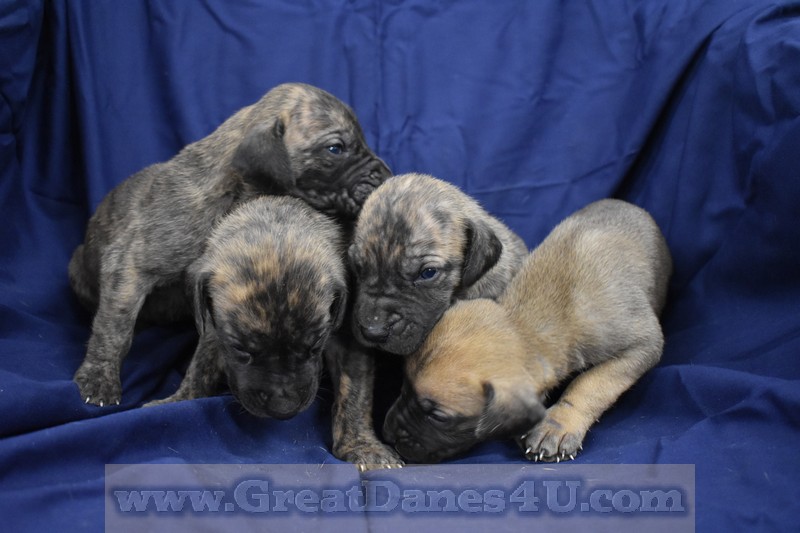
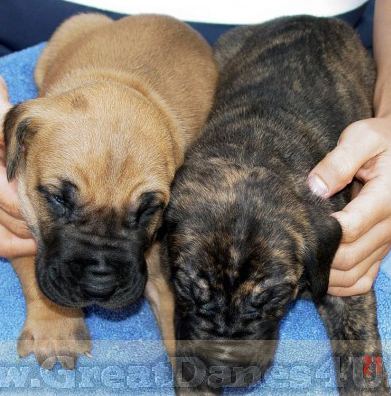
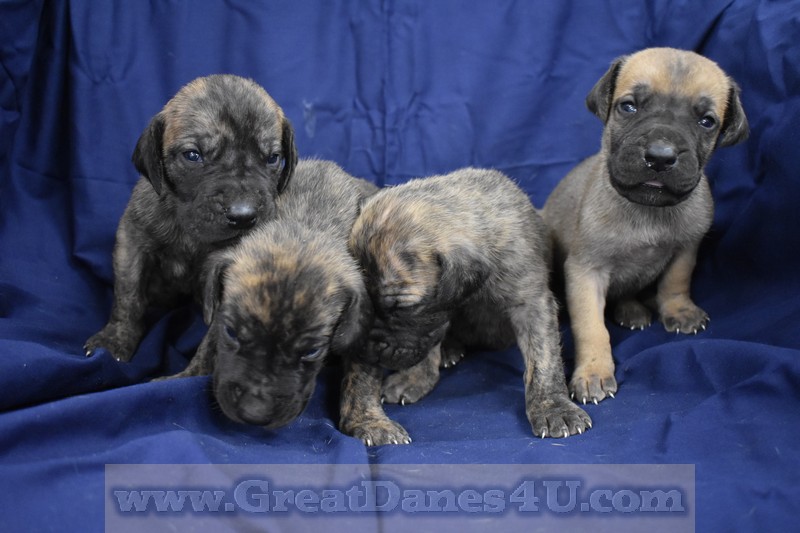
Great Dane stock is 4 to 5-Generation
Color-Pure and are Micro chipped plus all are DNA Profiled. Most of our
stock are OFA Certified, (Orthopedic Foundation for Animals), if age
appropriate.
Pups go micro-chipped, 2 applications of Kennel Cough, 2 Parvo shots, (or more), dewclaw removal and at least 1 Vet check, plus a
variety of wormers as the puppies bodies can handle the various types and most go home close to Housebroke!
Enclosed within this web site is Free Information about Great Danes Appearance, Standards, K-9 Care, this Breeder's Policies, Dane History and many Pictures of Great Danes. Please send your comments, suggestions, or to be registered in the litter email flier database; send you email request to: Sales@GreatDanes4U.com or just pick up the phone, call: 417-859-0844 to schedule a *LIVE* Web Cam appointment or for any further information!
GreatDanes4U uses this site to promote Healthy, Trained, Socialized Multi-Generation Color-Pure FAWN and BRINDLE AKC Great Dane Puppies, Big Pups and Dogs for sale as Family Pets, Breeding Quality and Show Potential pups and
Stud Service. Occasionally Black and Blue Great Dane puppies are also available.
Use Blue Menu Bar (Below), or Text link Site Map in footer to Navigate this extensive website.
http://www.napoleon.org.uk/health/entropian.htm
There are numerous eyelid disorders in dogs.
Entropian (rolling inwards), and ectropian (drooping or rolling
outward) are the most common and, although they are considered abnormal eyelid
conformations, are characteristics of many breeds. For example, droopy lower
eyelids (ectropion) are usually present in Basset hounds and other hound breeds.
The breeding of Shar Peis and Chow Chows, in which breeding selection has been
made for numerous facial wrinkles, has led to turning in of the eyelids (both
upper and lower in many cases).
Ectropian, unless very pronounced, does not lead to severe diseases of the eye
itself. However, the droopy eyelid may collect debris such as dust, pollen and
plant material from the environment. This may cause ocular irritation that leads
to discharge and a red eye. This is particularly pronounced in hunting dogs or
dogs that are outdoors much of the time. Dogs that have ectropion must be
watched carefully by their owners for possible foreign bodies in their eyes, and
the dogs' eyes must be cleaned and often medicated on a regular basis.
Entropion on the other hand frequently causes ocular pain and corneal disease.
If the eyelid is rolled inward sufficiently so that the hairs of the eyelid rub
on the eye, much damage may be done. Dogs with entropion usually squint and have
watery eyes. If the entropion is not corrected and the rubbing continues, ulcers
often develop on the cornea and the cornea becomes pigmented. Vision may be
lost. Dogs that have had entropion correction surgery cannot be shown.
Although entropion and ectropion are hereditary disorders in many breeds, their
mode of inheritance is complex. No one gene controls the development of eyelid
conformation. Instead, it is a combination of genes that control eyelid size and
shape, depth of the orbit (eye socket), size and shape of the eyes, head
conformation and amount of facial skin. All of these genes work in concert to
determine the relationship of the eyelids to the eye. Therefore if an eyelid
conformation defect is to be eliminated, only those dogs without entropion or
ectropin must be bred. In many cases this may be difficult as "abnormal" eyelids
may be a desirable breed standard.
The current recommendations for breeding dogs with ectropian is classified as a
"breeder option". This is because, although it is a hereditary problem, it is
usually not sight threatening. Entropion is a painful and potentially blinding
disease and therefore affected dogs in breeds that have a high incidence of
entropion (such as Bloodhounds, Chow Chows, English Bulldog, Standard Poodle,
Bull Mastiff, Chinese Shar Pei, Mastiff, Vizsla, and Saint Bernards) are not
denied certification. However, because exaggerated facial conformation with
loose skin and/or heavy facial folds often leads to eyelids that roll in or out
predisposed the animal to irritation, discomfort and possible vision loss,
selecting away from these traits in all breeds is strongly encouraged.
Affiliates And Sponsors:
|
Want to see what can happen to you & your family if have
Firestone A/T tires on your vehicle?
L Save your family, REMOVE Firestone tires NOW!!! L |
|||||||||||
![]() ![]() |
![]() ![]() |
![]() ![]() |
![]() ![]() |
||||||||
|
|
|
||||||||||
| Fair Grove Veterinary Service LLC P.O. Box 9 5348 E. State Highway CC Fair Grove, MO 65648 (417)759-7803 fgvs@fairgrovevet.com |
Link to
my Vet's web site![]() Link to an Awesome Disease & Pharmacy Library |
Fair Grove Veterinary Service provides you with a full library of pet medical information from the Veterinary Information Network. VIN is the world's first and largest online veterinary community, where new articles are added weekly by the experts at VIN to make sure that our readers have the most current veterinary information available. |
|||||||||
|
My Pet Outlet selected GreatDanes4U as their 2006 Puppy Website of the year!
|
![]() ![]() Congratulations! GreatDanes4U has been selected to earn the prestigious Top Dog Website Award for 2010 from www.TrainPetDog.com . This award is given to carefully chosen dog websites based on the information content and the overall layout. |
|
|||||||||
|
|
|||||||||||